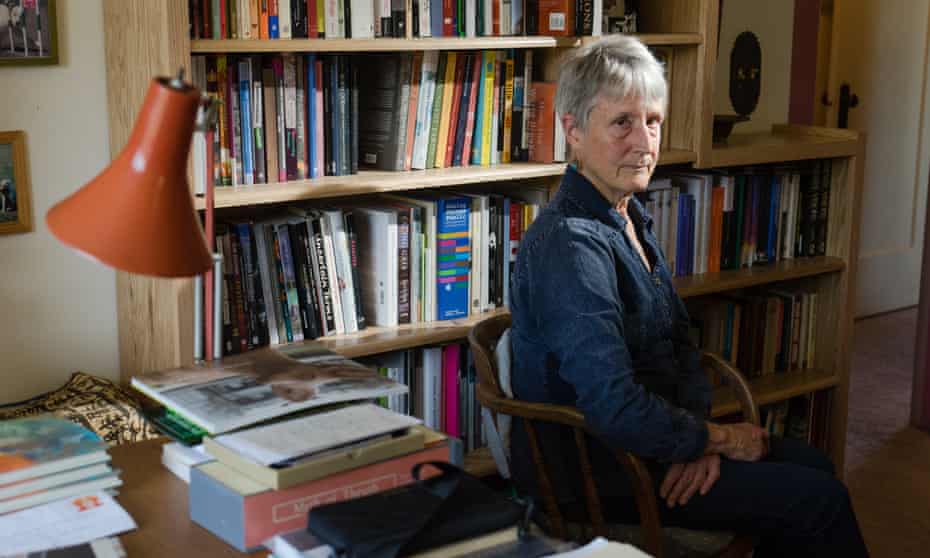
Ember Ortiz’s Blog #2-Exploring the Multifaceted Implications of Haraway’s ‘Making Kin’ in Ethics, Politics, and Environmental Activism

        Feminist cyborg scholar Donna Haraway: ‘The disorder of our era isn’t ...

          In her article titled “Anthropocene, Capitalocene, Plantationocene, Chthulucene: Making Kin,” Donna Haraway delves into the profound implications of both human and non-human activities on our planet. Haraway proposes a paradigm shift in our understanding of our relationship with the environment, advocating for a departure from the narrow focus on human impact in the Anthropocene era. Instead, she advocates for embracing the Chthulucene, which acknowledges the interconnectedness and interdependence of all forms of life on Earth. Haraway proposes a paradigmatic shift in our understanding of reproduction and family dynamics, urging us to move beyond the traditional emphasis on biological procreation and instead focus on cultivating meaningful bonds with non-human entities. By stating that humans should “make kin, not babies,” she contends that we can foster novel forms of kinship that prioritize interconnectedness and mutuality over hierarchical structures. This perspective not only challenges the anthropocentric view of human exceptionalism but also highlights the imperative of adopting more sustainable and equitable practices to ensure the well-being of all beings on the planet. But, what are the implications of Haraway’s call for “making kin” in terms of ethics, politics, and environmental activism? 

          Haraway’s proposition of “making kin” carries extreme ethical implications. She contends that it is important to acknowledge the autonomy and worth of non-human entities, and actively strive towards establishing sustainable and just modes of existence. This necessitates assuming accountability for our environmental impact, recognizing that our actions reverberate through future generations and the entire planet. Haraway writes “If there is to be multispecies ecojustice, which can also embrace diverse human people, it is high time that feminists exercise leadership in imagination, theory, and action to unravel the ties of both genealogy and kin, and kin and species” (161). The concept of ‘multispecies ecojustice’ encompasses an environmental justice approach that acknowledges the rights and welfare of all species, extending beyond the human realm. It underscores the imperative for fair treatment and inclusion of non-human entities in environmental decision-making procedures. By challenging the conventional anthropocentric perspective that places human interests above those of other species, this notion advocates for a more inclusive and holistic approach to environmental justice. Haraway asserts that feminists should assume a central role in promoting the concept of multispecies ecojustice. This argument posits that feminists possess the essential qualities, such as imagination, theoretical comprehension, and practical engagement, to navigate the intricate dynamics between genealogy (ancestry) and kinship (family ties) within and across different species. By unraveling these connections, feminists can contribute to a more comprehensive and inclusive understanding of justice that transcends anthropocentric perspectives, potentially targeting and challenging the notion of human exceptionalism.

          Haraway’s proposition to establish kinship also comes with political implications as it disrupts conventional understandings of familial ties, power structures, and modes of governance. By challenging traditional notions, her call prompts a reevaluation of existing social and political frameworks, paving the way for more inclusive and equitable systems. Traditional political systems have historically operated on the premise of hierarchies and dominance, where humans have exerted control over non-human entities solely for their own advantage. However, Haraway challenges this anthropocentric worldview by acknowledging the agency and interconnectedness of all beings. She advocates for a political framework that is rooted in mutual respect and reciprocity, rather than exploitation and subjugation. This necessitates a redistribution of power and decision-making processes to encompass non-human actors in political deliberations, recognizing their inherent value and contributions. Haraway explains that “‘Make Kin’ and ‘Not Babies’ are both hard; they both demand our best emotional, intellectual, artistic, and political creativity, individually and collectively, across ideological and regional differences, among other differences”(161). This is why Haraway advocates for the implementation of novel governance structures capable of accommodating the intricacies of the Chthulucene, a term she employs to depict the present era characterized by intertwined relationships among multiple species. Conventional political frameworks may lack the necessary tools to effectively address the complexities arising from these interconnections. As an alternative, Haraway proposes exploring models such as multispecies democracy or companion species governance, which acknowledge the agency and interests of non-human entities. Achieving this goal necessitates a fundamental reimagining of political institutions and practices, fostering inclusivity, participation, and responsiveness to the diverse needs of all forms of life.

          In conclusion, Haraway’s proposition to “make kin” carries profound implications for ethics, politics, and environmental activism. By prioritizing interconnectedness and mutuality over hierarchical structures, we have the potential to cultivate innovative forms of kinship that challenge the prevailing anthropocentric perspective of human exceptionalism. This perspective underscores the urgency of embracing sustainable and equitable practices to safeguard the well-being of all beings on our planet. Moreover, it compels us to acknowledge our environmental impact and assume responsibility for our actions, recognizing that their repercussions extend to future generations and the entire biosphere. This serves as an invitation to reconceptualize our connection with the natural world and foster a future that is characterized by inclusivity and justice for ALL living beings.

 

What is the “parable of the sower”?

For those who have not been forced to attend as much Sunday School as I was, here’s the “parable of the sower” from the Gospel of Matthew in the New Testament of the Christian Bible:

That same day Jesus went out of the house and sat beside the sea. And great crowds gathered about him, so that he got into a boat and sat there; and the whole crowd stood on the beach. And he told them many things in parables, saying: “A sower went out to sow. And as he sowed, some seeds fell along the path, and the birds came and devoured them. Other seeds fell on rocky ground, where they had not much soil, and immediately they sprang up, since they had no depth of soil, but when the sun rose they were scorched; and since they had no root they withered away. Other seeds fell upon thorns, and the thorns grew up and choked them. Other seeds fell on good soil and brought forth grain, some a hundredfold, some sixty, some thirty. He who has ears,[a] let him hear.”


10 Then the disciples came and said to him, “Why do you speak to them in parables?” 11 And he answered them, “To you it has been given to know the secrets of the kingdom of heaven, but to them it has not been given. 12 For to him who has will more be given, and he will have abundance; but from him who has not, even what he has will be taken away. 13 This is why I speak to them in parables, because seeing they do not see, and hearing they do not hear, nor do they understand. 14 With them indeed is fulfilled the prophecy of Isaiah which says:


‘You shall indeed hear but never understand,
    and you shall indeed see but never perceive.
15 For this people’s heart has grown dull,
    and their ears are heavy of hearing,
    and their eyes they have closed,
lest they should perceive with their eyes,
    and hear with their ears,
and understand with their heart,
    and turn for me to heal them.’


16 But blessed are your eyes, for they see, and your ears, for they hear. 17 Truly, I say to you, many prophets and righteous men longed to see what you see, and did not see it, and to hear what you hear, and did not hear it.

The metaphor of sowing seeds as a figure for a broader social and cultural restoration will be central to the novel, as you can perhaps detect already. More subtly but perhaps more importantly is the idea of the parable: how is the parable, a pithy form of transmitting wisdom via widely accessible, homely storytelling, relevant to a) what Lauren is up to in the novel and b) what Butler is up to with the novel?

For a deeper dive, you can check out the text in the Revised Standard Edition of the Bible here.

Death, Life, and Refuge

In Parable of the Sower, readers follow Lauren and her day-to-day life in this run-down environment. As she is biking to her makeshift baptism, death and violence is all that surrounds her. Headless corpses, naked and unaware wandering people, people riddled with disease, families beat and raped. But they turn a blind eye to avoid trouble, they turn a blind eye because it is normal to them. Living in this poor community, climate change and lack of resources combined worsen their living situations daily. Lauren seems to feel very insignificant in the midst of it all, “Maybe God is a kind of big kid, playing with his toys. If he is, what difference does it make if 700 people get killed in a hurricane—or if seven kids go to church and get dipped in a big tank of expensive water” (p17). The drastic comparison is necessary to emphasize how unimportant it might all feel to her even with her hyperempathy. It also draws a thin line between life and death as baptism is essentially being reborn as child of God. They lack the resources they need to live and are constantly scraping for something to survive on. God is not helping them and her reasoning is that they are just another one of God’s toys. Lauren’s life is constantly concerned and connectwed with death because death and life are at the center of nature. Haraway emphasizes this in her use of the term ‘Cthlulucene’ to name the era we are currently living through as a result of climate change. Cthlulucene is concerned with death and this idea that we are tangled in something that will eventually end in death, but not just ours as a human species, and that it welcomes all species’ into this inescapable nature’s web. That is the imagery that comes to mind with Haraways listing of mythological female creatures “Naga, Gaia, Tangaroa, Medusa, Spider Woman”. Cthlulucene is nurturing yet deadly.

Lauren keeps making this shift between an astronaut who died in March and how ignorant the reporting of that feels to her when the concerns she has to live with affect the survival of her and the people in her community. Why does the death of an astronaut matter when their peddlers (who provided water to the poor) are being killed and their water prices are rising? Their “water now costs several times as much as gasoline. But, except for arsonists and the rich, mostpeople have given up buying gasoline… It’s a lot harder to give up water” (p20). One of the reasons Haraway is so against using the term Anthropocene for this era is that is centers Humans which seems very arrogant of our species. Our species is not superior to any other species and is just as much a victim to climate change and slow violence. We are just as dependent on the same resources which we can see in Lauren’s situation. Water is so vital to any species – necessary for life – yet while her community is toiling over what solution they must find to get water the media is reporting on an astronaut’s death in Mars. Why does she get to be important than an entire dying community? But Lauren still holds an admiration for her because of what could be.

Lauren holds hope that space can serve as a refuge and chance to rebuild. It is why she holds an admiration for this astronaut, “She spent her life heading for Mars—preparing herself, becoming an astronaut, getting on a Mars crew, going to Mars, beginning to figure out how to terraform Mars, beginning to create sheltered places where people can live and work now” (p22). Although her father may not agree, Lauren has an anticipation and excitement for how far space exploration and colonization could go. If it works, it might just be their way out. Haraway holds a similar perspective on the importance of refuge. “I think our job is to make the Anthropocene as short/thin as possible and to cultivate with each other in every way imaginable epochs to come that can replenish refuge. Right now, the earth is full of refugees, human and not, without refuge”. Refuge is needed for all species on this dying earth for a chance to rebuild and replenish what we once had. There is no refuge on Earth to protect ourselves from climate change. Especially since we keep ignoring it.

“Cli-Fi” Convergence

“Cli-Fi” Convergence


Octavia Butler places the reader into a dystopian world that was caused by economic and environmental crises, unlike our world. Butler builds this world around the reader as a hopeless yet strangely possible future using vivid descriptions of the people and the society that the main character Lauren Olamina inhabits. Lauren in this story experiences the worst parts of society to a much greater extent as her condition of hyperempathy causes her to feel the emotional and physical pain of the people around her. Octavia Butler explores themes of religion through the early chapters of the book Lauren someone experiences all the emotions of the people around her to such an extent that she can not go through a ride to church without feeling a great deal of pain and suffering. Lauren fed up with Christianity decides to forsake her old religion of christianity in favor of her belief system “Earthseed”.


To take a step back from the plot of the novel many of the themes experienced by the reader and the main protagonist of Lauren are issues that many people today are dealing with and having to manage. The world of Parable of the Sower is mainly about a world that was created by humans to be on its last legs with the main glimmer of hope being the new religion of “Earthseed”. However, the ideas of slow violence presented by Rob Nixion are finally fully realized in this world. The violence of climate change and the economic problems lead to a world of suffering for all that inhabit it. This can be seen through when our main character Lauren states “A lot of the houses were trashed-burned, vandalized, infested with drunks or druggies or squatted in by homeless families with their filthy, gaunt, half-naked children.” With the world that the people in this world once knew completely devoured by the earth itself, people are left with no other option but to succumb to their circumstances. The inhabitants of this planet no longer have the will or the means to fight for their existence in the world in which they live. Another point that affects readers is the period that the story takes place, between 2024-2025. While this book was written during the 1990s readers today are taken back a little but by the period, the world is slowly looking more and more like the one described in the novel. Personally, one line that sticks out to me is seen on page 62 where Lauren states “ignoring fire in the living room because we’re all in the kitchen, and besides, house fires are too scary to talk about” This line people to the current state that the world is in today. Many of the global leaders for years have avoided talking about the effects of climate change and the possibilities for damage to the planet that humans are having. This is because “House fires are too scary to talk about”

Making a better place

In the novel, “Parable of the Sower” by Olivia Butler, it tells a story of how a teenage girl who just turned fifteen comes to a realization about how the environment is slowly deteriorating. Nature itself is very important because our forests, rivers, oceans, and soils give us the food we eat, the air we breathe, and the water we need to irrigate our crops. Nixon’s “slow death,” Haraway’s “Chthulucene,” or Lemenager’s “everyday Anthropocene,all explained the severity of Climate change and accurately described the damages it causes, giving readers a sense of empathy. Since Climate change is the main focus of this Novel, Lauren lives through its effects in her day to day life. In the Novel it states that “ Things are changing now too. Our adults haven’t been wiped out by a plague so they’re still anchored in the past, waiting for the good ol days to come back. But things have changed a lot, and they’ll change more. Things are always changing. This is just one of the big jumps instead of the little step by step changes that are easier to take. People have changed the climate of the world. Now they’re waiting for the old days to come back” (Butler, 20) .Why is the planet slowly dying?  Why are humans the main cause? It makes people think about what has led to this unfortunate event? In the year 2024, Laura’s life has changed because she constantly has to worry about her future and how worse it could possibly get if people do not take the action to make that one change. She also noticed how people suffered and it affected their livelihood which caused emotional damages to her which made her very vulnerable but resilient. “ I can’t do a thing about my hyperempathy, no matter what dad thinks or wants or wishes. I feel what I see others feeling or what I believe they feel” (Butler, 5). Cli-fi draws empathy towards people which is important in writing novels. You want to raise awareness and make people emotional even though pictures are not involved, they will have an imagination of the terrors of catastrophes like storms, meltings of polar ice, rising sea levels which can all cause death in the animal kingdom. 

On the other hand, Nixon made a very good example of Climate change and articulated himself very well. Nixon’s “ Slow violence” was explained as slow torture, something where the pain would last longer. He stated in his book, “The long dyings—the staggered and staggeringly discounted casualties, both human and ecological that result from war’s toxic aftermaths or climate change—are underrepresented in strategic planning as well as in human memory” ( Nixon, 4). This was an issue that is present in Butler’s Novel. The deterioration of the planet. Lauren’s hometown hasn’t been the same as before, and throughout the years of climate change its decline will only get worse. It made me as a reader have an emotional connection to both Novels because this is something that is very timely and relevant to the present. The goal is to use our emotions to make a change and understand every crisis that is happening in the world. Tragedies happen, people die, drugs, animal abuse, murder, corrupt politics, financial crisis, but what can we do to make a change. Fortunately, with the help of authors like Butler, Lemenager, and Nixon they make us relate to each other in a way that we would want to step forward and make a change.